
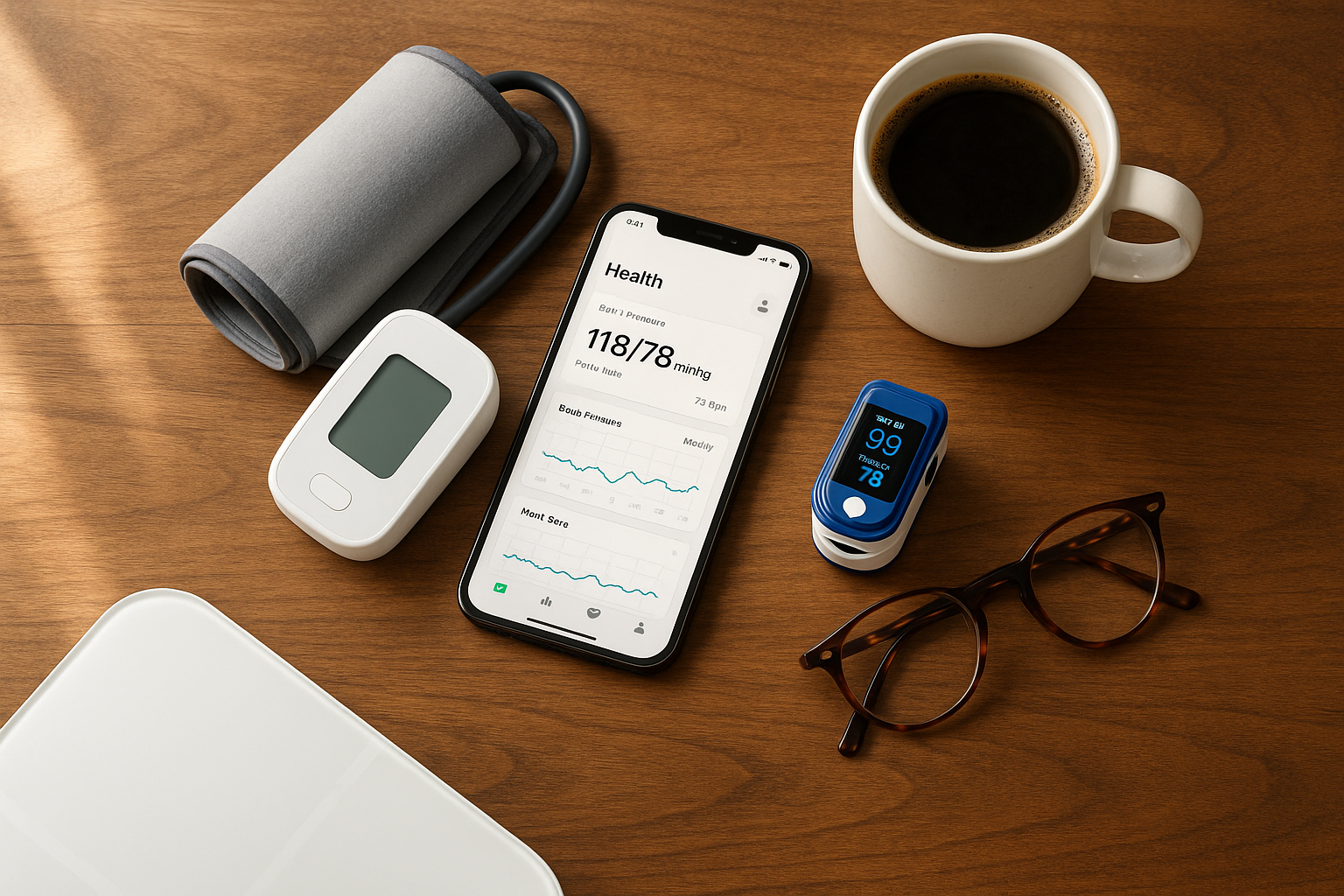
Best Health Monitoring Devices for Seniors in 2026: Blood Pressure, Glucose & More

As I said before, I live three hours away from my sister. So when I visit her, I try to make the most of it. Doctor appointments are always on my list — not because she can’t go alone, but because I hear things differently than she does. I ask questions she forgets to ask. I remember the details she brushes off.
This particular visit was her quarterly checkup. Everything seemed routine until the doctor frowned at the blood pressure reading.
“How often are you checking this at home?” the doctor asked.
My sister looked at me. I looked at her. We both knew the answer: she wasn’t.
That moment changed everything. I went home and started researching health monitoring devices — things she could use at home, every day, without it feeling like a chore.
What I found surprised me. These devices have gotten so simple that my 85-year-old sister now uses them without complaining. (And believe me, she complains about everything.)
Want to know how to pick the best health monitoring devices for seniors? Let me share what works and what doesn’t.
Why Home Health Monitoring Matters
Here’s what 20-plus years of caregiving has taught me: health problems sneak up on you.
High blood pressure doesn’t hurt. High blood sugar doesn’t hurt. Low oxygen levels don’t hurt. These things build up quietly for weeks, months, even years. Then one day — boom — you’re calling 911.
Home monitoring catches these problems early, when they’re still easy to manage.
Now, I understand why some seniors push back on this. Nobody wants their home to feel like a doctor’s office. Nobody wants to spend their retirement poking fingers and wrapping cuffs around their arm all day.
That’s why the best devices today are the ones that make it so easy, you barely notice you’re doing it.
Blood Pressure Monitors
If your loved one only gets ONE device, make it a blood pressure monitor. High blood pressure is the most common health issue for seniors, and it’s the easiest to track at home.
My Top Pick: Withings BPM Connect — $109.95
Why I love it: It sends your readings to your phone automatically. No writing anything down. No paper logs. No forgetting your numbers before the next doctor visit.
Here’s how simple it is: wrap the cuff around your arm, press one button, wait 30 seconds. Done. The screen shows your reading, and the app on your phone saves it at the same time.
The app is really smart, too. It color-codes everything:
- Green = your numbers look good
- Yellow = a little high, keep an eye on it
- Red = call your doctor
You can share the app with family members or your doctor so everyone stays in the loop — without those “Did you check your blood pressure today?” phone calls.
The battery lasts about 6 months. You charge it with a regular USB cable.
My sister has used this every morning for eight months now. She doesn’t love it, but she doesn’t hate it either. For her, that’s practically a five-star review.
Best for: Anyone who needs to check blood pressure regularly but hates keeping paper logs.
👉 Get the Withings BPM Connect on Amazon (I may earn a small commission at no extra cost to you)
Budget Pick: Omron Evolv — $74.97
Why it’s great: If arthritis or stiff fingers make it hard to wrap a traditional cuff, this one is for you.
The Omron Evolv is one piece — no separate cuff, no tubes. You just slide your arm through it and press the button. That’s it.
It connects to your phone through the Omron app, so your readings get saved automatically.
The app isn’t quite as pretty as the Withings one, but it gets the job done.
Best for: Seniors with arthritis or anyone who struggles with regular blood pressure cuffs.
👉 Get the Omron Evolv on Amazon
Best for Accuracy: Omron Platinum — $96.33
Why doctors recommend it: This is the monitor cardiologists trust when accuracy really matters.
It’s a traditional upper-arm cuff (not a wrist monitor — those aren’t as accurate). It can detect irregular heartbeats and something called “morning hypertension,” which is when blood pressure spikes right after you wake up.
It connects to the Omron app just like the Evolv.
If your loved one has serious heart issues, this is the one to get.
Best for: Anyone with diagnosed heart problems where accuracy is critical.
👉 Get the Omron Platinum on Amazon
Blood Sugar (Glucose) Monitors
If your loved one has diabetes, keeping track of blood sugar is a daily reality. The good news? It’s gotten a LOT easier than it used to be.
The Big Change: Continuous Glucose Monitors (CGMs)
Cost: Varies by insurance — $0 to $50/month with coverage, $100 to $400/month without
These are game-changers. A tiny sensor goes on your arm, and it checks your blood sugar every few minutes, all day and all night. No finger pricks. No test strips. No remembering to check before meals.
The sensor lasts 10 to 14 days, then you swap it for a new one. Your readings show up on your phone in real time. You can even share access with family members.
My picks:
- Dexcom G7 — most accurate
- FreeStyle Libre 3 — more affordable
Talk to your doctor first — many insurance plans now cover these, especially for insulin-dependent diabetes.
Best for: Anyone with diabetes who wants to stop pricking their fingers every day.
For Occasional Checking: Contour Next One — $19.97
If you only need to check blood sugar a few times a week (or your insurance doesn’t cover a CGM), this little meter is excellent.
It connects to your phone through Bluetooth, so your readings get saved in the app automatically.
My favorite feature: if you don’t get enough blood on the test strip the first time, you get 60 seconds to add more blood to the SAME strip. No wasting strips. (If you’ve ever used a glucose meter, you know how frustrating wasted strips are.)
Results come back in 5 seconds. The meter is small enough to fit in a purse or pocket.
Test strips cost about $20 to $30 for a box of 100.
Best for: People who check blood sugar occasionally and want something simple and affordable
👉 Get the Contour Next One on Amazon
Pulse Oximeters: Checking Oxygen Levels
After COVID, everyone learned what a pulse oximeter is. For seniors with breathing problems, heart failure, or COPD, these little devices are really important.
Best for Overnight Monitoring: Wellue O2Ring — $179.99
Why it’s special: Most pulse oximeters just take a quick reading when you clip them on your finger. This one is different — you wear it on your finger while you sleep, and it monitors your oxygen levels ALL NIGHT.
If your oxygen drops too low, it vibrates to wake you up.
This is a big deal for people with sleep apnea, heart failure, or COPD. Your oxygen can drop dangerously low while you’re sleeping, and you’d never know it.
In the morning, you can look at a report that shows exactly what happened overnight. You can share it with your doctor, too.
Best for: Anyone with breathing or heart problems who needs overnight monitoring.
👉 Get the Wellue O2Ring on Amazon
Budget Pick: Innovo Deluxe Fingertip Pulse Oximeter — $31.49
Why it works: For quick spot-checks — like when you’re feeling short of breath or before exercise — this simple clip-on oximeter does the job perfectly.
Clip it on your finger, wait 10 seconds, read the numbers. That’s it. No apps, no syncing, no fuss.
It’s FDA-approved and very accurate.
Best for: Quick checks when you want to know your oxygen level right now.
👉 Get the Innovo Pulse Oximeter on Amazon
Smart Scales
If your loved one has heart failure or kidney disease, tracking weight every day is really important. A sudden jump in weight often means the body is holding onto extra fluid — and that can be dangerous.
My Top Pick: Withings Body+ — $129.95
Why I chose it: It looks like a regular bathroom scale. You step on it, and it automatically saves your weight to the app. No buttons to press. No numbers to write down.
It also measures body fat, muscle mass, and water percentage — but honestly, the most important thing is that it tracks your weight over time so you can spot sudden changes.
It recognizes up to 8 different people automatically. So if two seniors share a household, the scale knows who’s who and saves the right data to the right person’s account.
Battery lasts about 18 months on regular AAA batteries.
Best for: Anyone who needs to track weight trends, especially people with heart failure.
👉 Get the Withings Body+ on Amazon
Budget Pick: RENPHO Smart Scale — $24.99
Does the basics well — tracks weight, body fat, and BMI. Connects to your phone through Bluetooth. Not as fancy as the Withings, but gets the job done for less than half the price.
Best for: Families on a budget who just need simple weight
👉 Get the RENPHO Smart Scale on Amazon
Heart Rhythm Monitor: KardiaMobile 6L — $109
Atrial fibrillation (also called “AFib”) is a dangerous heart rhythm problem that makes strokes more likely. The tricky part? It comes and goes. You might feel fine at the doctor’s office, but have an episode at home.
KardiaMobile 6L lets you take a medical-grade heart reading anytime, anywhere. Just place your fingers on the sensors for 30 seconds, and it tells you if your heart rhythm is normal or not.
If it finds something concerning, you can email the report directly to your doctor. Many cardiologists now tell their patients to get one of these because it catches problems that would never show up during a scheduled appointment.
You do NOT need a monthly subscription. The basic heart reading feature works without paying anything extra.
Best for: Anyone with known or suspected heart rhythm problems.
👉 Get the KardiaMobile 6L on Amazon
Smartwatches: The All-in-One Option
If your loved one is comfortable with technology, a smartwatch can do a little bit of everything: heart rate, blood oxygen, fall detection, and activity tracking — all on their wrist.
Apple Watch Series 11 — Starting at $299
The Apple Watch can can spot signs of chronic high blood pressure and notify you of possible hypertension and take an ECG anytime. Get notifications for a high and low heart rate, an irregular rhythm, and possible sleep apnea. View overnight health metrics with the Vitals app and take readings of your blood oxygen and has other safety features including Emergency SOS, fall detection and crash detection if you don’t respond.
The downside? It does SO much that it can be overwhelming for someone who just wants simple health tracking.
Best for: Seniors who already use an iPhone and like technology.
👉 Get the Apple Watch Series 11 on Amazon
Samsung Galaxy Watch 7 — $167.41
Similar health features to the Apple Watch, but for people who use Android phones. The sleep tracking is especially good.
Best for: Android phone users who want health tracking on their wrist.
👉 Get the Samsung Galaxy Watch 7 on Amazon
How to Pick the Best Health Monitoring Devices for Seniors
Don’t buy everything at once. Start with the ONE device that addresses your biggest health concern:
- High blood pressure? → Get a blood pressure monitor
- Diabetes? → Get a glucose monitor
- Heart problems? → Get a KardiaMobile or smartwatch
- Breathing issues? → Get a pulse oximeter
- Heart failure? → Get a smart scale AND a pulse oximeter
My advice?? Let your loved one get comfortable with that ONE device first. Then add more later if you need to or if you want to.
What I Actually Bought for My Sister
You may be wondering how to pick the best health monitoring devices for seniors? Here’s exactly what I picked and what she uses every day:
- Withings BPM Connect — checks blood pressure every morning
- Contour Next One ($28 + $25/month for strips) — checks blood sugar 2-3 times a week
- Innovo pulse oximeter — uses occasionally when she feels short of breath
- Withings Body+ scale — steps on it every morning
Total to get started: About $280 Monthly cost after that: About $25 (just for glucose test strips)
Was there some pushback at first? You bet. But here’s what I told her: “Just try it for two weeks. If you hate it, we’ll stop.”
You know what happened? She actually started getting interested in her own numbers. “Look, my blood pressure is lower this week!” she told me on the phone. She was actually excited about it.
That’s the secret — once people see their own numbers improving, they WANT to keep checking.
The Bottom Line
Home health monitoring doesn’t have to be complicated or stressful.
The devices I’ve shared with you today are simple enough that my 85-year-old sister uses them every day without help. If she can do it, with her subborness…your loved one probably can too.
Don’t overload them with stuff. Ease them into one device. Let them get comfortable. Then add more later.
The peace of mind — for both the senior and the caregiver — is worth every penny. These devices catch problems early, give doctors better information, and help your loved one stay in their home longer.
And honestly? It feels good to know that someone you love is being looked after, even when you’re three hours away.
Ready to Get Started?
Here are my top picks — click any link to see it on Amazon:
| Device | Best For | Price |
|---|---|---|
| Withings BPM Connect | Blood Pressure | $129.95 |
| Contour Next One | Blood Sugar | $19.97 |
| Wellue O2Ring | Overnight Oxygen | $179.99 |
| Innovo Pulse Oximeter | Quick Oxygen Check | $31.49 |
| Withings Body+ | Weight Tracking | $129.95 |
| KardiaMobile 6L | Heart Rhythm | $109.00 |
| Apple Watch Series 11 | All-in-One (iPhone) | $299.00 |
| Samsung Galaxy Watch 7 | All-in-One (Android) | $167.41 |
And for the complete guide covering ALL aging-in-place technology (not just health monitoring), grab my free guide:
Get Your Free Guide: “Technology That Actually Helps”
Worried about medication management too? Read my guide to Smart Medication Dispensers That Actually Work or compare the Best Medical Alert Systems for Seniors.
Disclosure: This post contains affiliate links. If you click through and buy something, I may earn a small commission at no extra cost to you. I only recommend products I’ve researched and truly believe will help your family. Your trust means everything to me.